

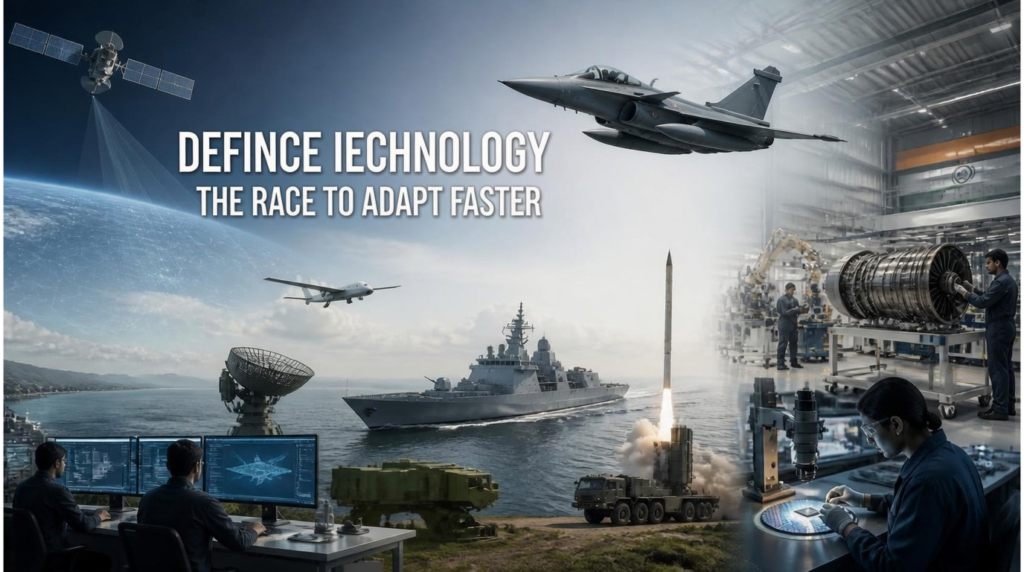
Defence Technology Weekly
Technology, Adaptation and the Military Industrial Base | 6–12 August 2026
The important defence-technology story this week is not one spectacular new weapon. It is the growing connection between technology, production capacity and speed of adaptation.
Across India and other major defence ecosystems, missiles, autonomous systems, radar, software, advanced materials and new manufacturing methods continue to receive attention. But an equally important change is taking place behind these technologies: armed forces are looking for ways to move new capabilities from laboratories and companies into operational units much faster.
For a nation’s military industrial base, that may be as important as the technology itself.
India: Missiles, Propulsion and Industrial Capability
India’s defence technology developments during the period illustrate several different layers of an industrial base.
On 6 August, India successfully conducted an operational user launch of the Agni-4 intermediate-range ballistic missile from the Integrated Test Range at Chandipur. The test was conducted under the Strategic Forces Command and validated operational and technical parameters.
From an industrial-base perspective, a mature missile capability involves much more than possessing the missile. Propulsion, guidance, electronics, specialised materials, testing facilities, manufacturing quality and long-term maintenance all have to function together.
There were also developments around combat-aircraft propulsion.
Reporting during the week said that a proposed Safran–GTRE 120 kN-class fighter engine programme was progressing through the Indian approval process. This should still be treated as a reported proposal rather than an approved programme.
Nevertheless, the subject itself is important. Aero-engines remain one of the most difficult technologies for a country seeking greater independence in military aviation. Genuine domestic capability would require not merely assembly, but expertise in design, high-temperature materials, turbine technology, manufacturing, testing and certification.
That makes propulsion an industrial-base issue rather than merely an aircraft issue.
There was also reporting about possible Indian participation in France’s future combat-aircraft programme. No formal Indian entry agreement or funded work package was publicly established during the period reviewed. It is therefore better viewed as an area of interest rather than an established programme.
Source: Global Defense Insight — Indian Defence Industry Weekly Development Report, 3–9 August 2026
Unmanned Systems: The Technology Is Only Part of the Story
Unmanned systems remain one of the clearest examples of how warfare is changing the defence industrial base.
Indian company Larsen & Toubro unveiled the Vedh Mk-1 unmanned system and its Chanakya autonomy framework during the recent reporting period, while production of 100 Teer manoeuvrable recoverable aerial targets for the Indian Air Force was reported to be underway.
The broader lesson from contemporary warfare is even more important.
Reconnaissance drones, communications-relay systems, electronic warfare, interceptor drones and strike systems increasingly operate as parts of a wider network.
Battlefield experience can also flow back to engineers and manufacturers, allowing equipment and software to be modified and returned to operational units rapidly.
This has major implications for the traditional military industrial base.
The older model often involved developing a platform, testing it for years, entering production and operating substantially the same configuration for a long period.
The emerging model is more circular:
Develop → Produce → Deploy → Learn → Modify → Produce again.
Industrial competitiveness may therefore increasingly depend upon how quickly this cycle can operate.
Maritime Technology: Moving Innovation Faster
A significant development came from the United States Navy on 11 August.
The Department of the Navy Rapid Capabilities Office established the National Security Plug and Play Consortium. Its purpose is to help integrate advanced technology into operational systems at greater scale and speed.
This deserves attention because defence innovation frequently encounters a difficult gap.
A promising technology can work in a laboratory or demonstration but still take years to become a usable military capability.
Reducing that gap requires acquisition processes, systems integration, testing infrastructure, standards and companies capable of manufacturing the technology.
In other words, procurement architecture itself can become part of technological capability.
A drone demonstrated independently is interesting technology. A drone that can exchange information and operate alongside ships, submarines, aircraft and allied command networks becomes military capability.
Radar and Sensors: Sovereign Technology Matters
Radar may receive less public attention than missiles and combat aircraft, but sensors sit near the centre of modern warfare.
Long-range detection, tracking, fire control, electronic warfare and integrated air defence depend upon increasingly sophisticated sensor networks.
Countries capable of designing and manufacturing these technologies also retain valuable engineering expertise in semiconductors, signal processing, software, antennas, electronic components and systems integration.
The industrial value therefore extends far beyond an individual radar.
The same principle applies to electronic warfare, secure communications and battlefield networks. Increasingly, the effectiveness of an individual weapon depends upon the information network surrounding it.
Software Is Becoming Part of the Defence Industrial Base
An important research development published on 10 August examined Software-Defined Defence and the transfer of civilian technology into military applications.
The central problem identified by the researchers is straightforward: military platforms can remain in service for decades, while their software and AI models may need to change in days or even hours. The researchers describe this as a lifecycle paradox and identify software and systems engineering, trustworthy AI, connectivity and infrastructure as interconnected parts of the problem.
This changes how we should think about a military industrial base.
Historically, industrial strength could often be seen physically—shipyards, aircraft factories, steel plants, ammunition factories and engine facilities.
Those remain essential.
But national defence capability increasingly also depends upon software engineers, semiconductor capability, communications infrastructure, simulation, cybersecurity, data systems and rapid software certification.
The military industrial base is becoming partly digital.
Advanced Manufacturing and Materials
India also provides useful examples of technologies further down the defence supply chain.
Recent reporting has highlighted Indian work in areas such as large-format additive manufacturing for aerospace composite tooling and advanced high-strength aluminium alloys with possible aerospace and defence applications.
These developments may appear less dramatic than a missile launch, but they are exactly the type of capabilities that determine whether a country can sustain sophisticated defence manufacturing.
Imported platforms can provide military capability.
Domestic knowledge of materials, tooling, manufacturing processes and testing helps create industrial capability.
The distinction matters.
What This Week Tells Us About the Military Industrial Base
Several themes connect these apparently different developments.
First, missiles and precision weapons require manufacturing depth. Having a design is not enough. Nations need propulsion, electronics, materials, test infrastructure, production lines and dependable supply chains.
Second, autonomous systems favour rapid industrial adaptation. Operational experience demonstrates the value of connecting military users directly with developers and manufacturers.
Third, software is becoming an industrial capability. Future aircraft, ships, vehicles, sensors and autonomous systems will increasingly improve through software rather than physical redesign alone.
Fourth, materials and manufacturing technologies remain fundamental. Additive manufacturing, composites, specialised alloys and precision production may receive little public attention, but they underpin advanced weapons.
Finally, speed matters.
The United States Navy’s new rapid-acquisition consortium reflects a wider problem faced by defence establishments: commercial technology can advance faster than conventional military procurement. The Navy explicitly describes its new consortium as a mechanism for integrating advanced technology into operational systems at “scale and speed.”
Countries that learn to combine military requirements with commercial innovation, manufacturing scale and rapid operational feedback could therefore gain an important advantage.
Closing Thought
The military industrial base of the future will not be defined only by how many factories a country possesses.
Factories remain essential, but they increasingly sit inside a larger ecosystem of research laboratories, universities, startups, software companies, electronics manufacturers, materials specialists, testing facilities, traditional defence primes and military users.
The decisive capability may ultimately be the ability to connect all of them.
A nation that can learn, engineer, manufacture, deploy and then learn again faster than its competitors possesses something more valuable than an individual advanced weapon.
It possesses an adaptable military industrial base.
Sources
Indian defence developments: Global Defense Insight — Indian Defence Industry Weekly Development Report, 3–9 August 2026
Agni-4: DD India reporting on the 6 August 2026 test from the Integrated Test Range at Chandipur.
Rapid technology acquisition: U.S. Navy — National Security Plug and Play Consortium announcement
Software-Defined Defence: White paper — A Perspective on Civilian-to-Defence Research Transfer to SDD